The Real Challenges at Indonesian Gold Jewelry Stores
Jewelry store owners in Indonesia know how difficult it is to manage hundreds or thousands of individual pieces. Every morning, staff must count every tray by hand, a process that takes 1 to 2 hours and remains error prone no matter how carefully it is done.
The most common problems:
- Missing items: Small pieces are easily lost, mixed up, or left unrecorded when moved between trays
- Slow stock counts: Manually counting 500+ pieces is time consuming and highly prone to human error
- Sales not recorded in real time: Transactions happen, but stock is updated manually at the end of the day
- Difficult audits by display area: There is no way to know exactly how many items are in Display A vs. Display B without a physical count
The solution? An RFID system designed specifically for jewelry stores.
How RFID Works in a Jewelry Store
RFID in a jewelry store differs from a warehouse deployment: every individual piece of jewelry gets its own unique RFID tag. Here's the workflow:
1. Tagging: Every Item Gets a Digital Identity
Every ring, necklace, bracelet, or earring is fitted with a small RFID tag (typically a resin-coated hang tag or a waterproof sticker). The tag stores a unique code linked to the product data: jewelry type, gold weight, purity, and supplier.
2. Inbound: Automatic Registration of Incoming Stock
When new stock arrives, a desktop RFID reader can read multiple tags in one process. Item count and processing time depend on the reader, tags, and item conditions; measure throughput with samples on site.
3. Tray Audits in Seconds
With a handheld RFID scanner, staff sweep the scanner over a jewelry tray. The system instantly displays:
- Total items in the tray: 48 expected vs. 47 found → 1 item missing, detected immediately
- A real time comparison against system records
Audits that used to take 1 to 2 hours can be completed in 5 to 10 minutes for the entire store.
4. Outbound: Sales Recorded Automatically
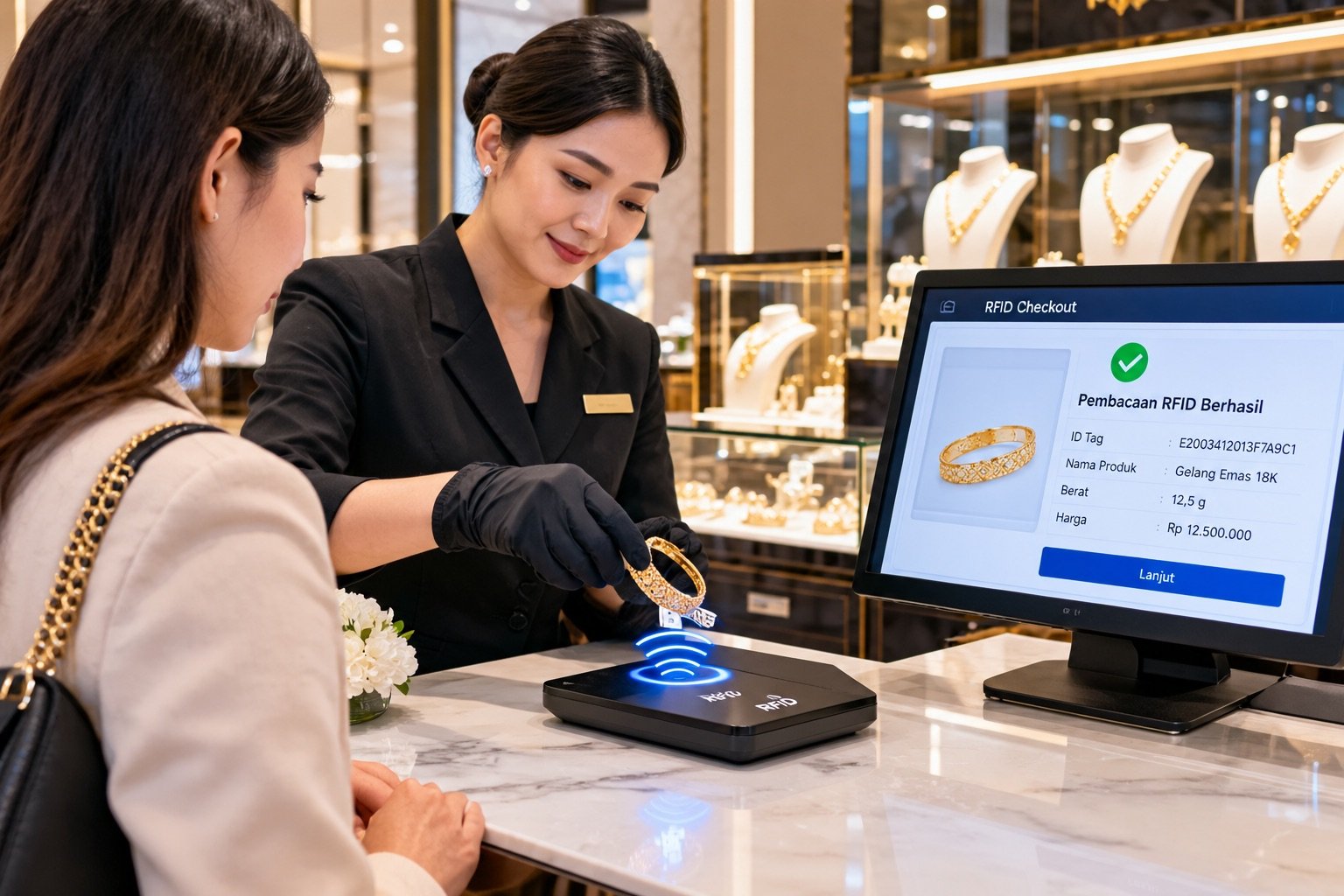
When an item is sold, staff scan its RFID tag at a reader → the system automatically records the outbound transaction, reduces stock, and removes the tag from active inventory.
5. Reusable Tags, Less Waste
The most important feature for jewelry stores: reusable tags. When an item is sold, the tag is removed and reassigned to new incoming stock. One tag can be used again and again, so the tag supply only needs to cover the items currently in the store.
Example Scenario: RFID in a Jewelry Store
The following illustrative scenario shows how RFID supports the tracking of high value items in a typical jewelry store.
Before RFID:
- Daily stock audits are performed manually, tray by tray
- Item movements between display cases are hard to track
- No real time visibility of stock by area
Solution:
- Every piece of jewelry fitted with a reusable RFID tag carrying a unique serial number
- A handheld scanner for daily tray audits
- A desktop USB reader for inbound and outbound processing
- Integration with the store's existing jewelry management or POS platform
Expected results:
- Daily audits that took 1 to 2 hours are completed in minutes
- Every item movement is recorded, so a missing item is detected the same day
- Reusable tags: when an item is sold, its tag is immediately reused for new stock
- RFID data and the store's existing platform stay synchronized
Integration with Your Existing Platform
Jewelry stores typically already use specialized jewelry POS software, Accurate, or their own system. Katalyst Technology can integrate with your existing platform, so RFID data flows automatically into the system you already use.
There's no need to replace your current system or retrain staff from scratch. Katalyst becomes the RFID layer on top of your existing software.
Recommended Hardware Setup for Jewelry Stores
For a small to medium jewelry store, the typical recommended configuration is:
- 1× desktop USB RFID reader: For inbound, outbound, and cashier operations
- 1× handheld RFID scanner: For tray audits and full store stocktakes
- Reusable RFID tags: Quantity matched to the number of active items (typically 200 to 500 tags for a small to medium store)
- RFID label printer (optional): For printing combined barcode and RFID labels in one step
Common Questions from Jewelry Store Owners
Are RFID tags safe for gold jewelry? Yes. The tags are non-metallic with a resin or plastic coating; they don't damage jewelry and can be removed at any time. Some stores use hang tags tied to the item.
Can this be used for gold bullion? Yes, by attaching sticker or hard RFID tags to the bullion packaging or storage container.
How long does implementation take? Duration depends on item count, tagging workflow, equipment availability, and the store's systems. Estimate it after an assessment.
Can it support tax or VAT reporting? Katalyst can export transaction data in formats compatible with your reporting requirements.
Start with a Free Demo
Katalyst Technology offers a free demo for jewelry store owners who want to see the system in action. You can also book a free consultation to walk through your store's workflow with our team.
Schedule a demo now. Our team is ready to help you implement RFID in your jewelry store.