What Is RFID Inventory Management?
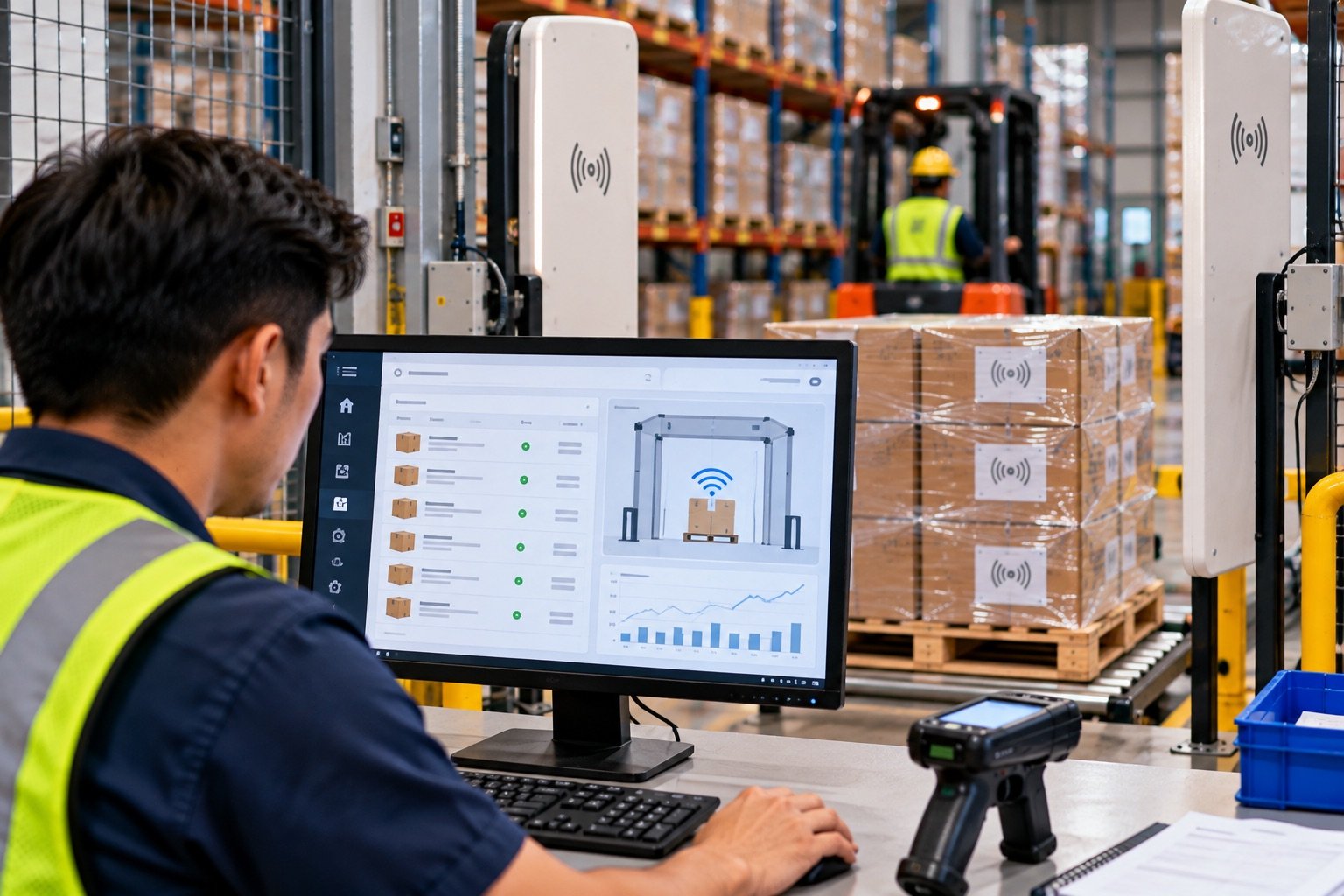
RFID (Radio-Frequency Identification) inventory management uses radio waves to automatically identify, count, and locate every item in a warehouse or store, without manual barcode scanning. Each item carries an RFID tag, and a reader (handheld, desktop, or fixed gate) captures hundreds of tags at once in seconds.
For Indonesian businesses, RFID is quickly moving from "enterprise luxury" to "operational necessity", driven by the growing burden of manual stock counts, stricter audit requirements, and demands for supply chain transparency from international partners.
Why Indonesian Businesses Are Adopting RFID Now
Several factors are accelerating RFID adoption across Indonesia's warehouses and factories:
- Labor intensive stock counts: Manual counting ties up staff for days at a time, and the burden grows with every new SKU and location
- ISO and audit requirements: Exporting to international buyers or partnering with multinational corporations demands traceability that spreadsheets cannot provide
- Shrinkage: Inventory shrinkage costs Indonesian retailers and manufacturers 1 to 3% of annual revenue; RFID's EPC tracking of each individual item closes that gap
- Complex layouts with many zones: Factories in Java's manufacturing corridors manage sprawling layouts with many areas, where manual tracking breaks down
- Integration pressure: ERP systems like Odoo, SAP, and Accurate are now standard at mid-size Indonesian companies; RFID provides the real time data layer these platforms need
What an RFID Rollout Includes
A practical UHF RFID rollout has three layers:
- Tags for cartons, pallets, assets, jewelry, tools, or fixed equipment
- Readers such as handheld scanners, desktop readers, and fixed gate readers
- Software for inventory visibility, audit workflows, user roles, reporting, and ERP integration
The right mix depends on item material, read distance, number of locations, tag volume, reader placement, integration needs, and rollout support.
Scoping Your Rollout
During a consultation, we map:
- Item categories and tag requirements
- Warehouse areas, gate points, and audit workflows
- The reader mix for handheld, desktop, and fixed reader operations
- Integration targets such as Odoo, Accurate, SAP, WMS, spreadsheets, or internal systems
- Training, deployment timeline, and support expectations
The output is a rollout plan covering hardware, software scope, and timeline.
Representative Workflow Patterns
Katalyst supports common UHF RFID workflows for Indonesian operations teams:
- Timber and pallet operations that need faster stock audits and zone visibility
- Jewelry and other high value retail workflows that need reusable tag management
- Warehouses connected to an ERP that need inbound, outbound, and audit events synced to existing systems
How to Choose an RFID Vendor in Indonesia
When evaluating RFID vendors, ask these questions:
- Do they cover the complete rollout? Software, hardware, implementation, training, and support. Fragmented vendors create integration headaches
- Do they have live references? Look for demonstrated results with real Indonesian clients (ideally in your industry)
- What's their ERP integration story? If you run Odoo, SAP, or Accurate, ask for a proof of concept
- How fast can they deploy? Large legacy vendors can take months; smaller specialists like Katalyst deploy in weeks
- Is the total cost transparent? Ask which items are one-time (hardware, tagging, setup) and which are ongoing (software, support), and compare vendors over the same multi-year period
Common Mistakes to Avoid
- Buying hardware before choosing software: Tags and readers need to be compatible with your platform's EPC format and encoding approach
- Skipping the parallel run: Going live cold (dropping your old system on day 1) creates chaos; run both systems side by side for 1 to 2 weeks
- Underestimating tag count: Plan for 20 to 30% extra tags to cover damaged or lost tags and new stock
- No SOP documentation: Technology without process change fails; invest time in SOPs and training
- Ignoring fixed reader opportunities: If you have a clearly defined outbound gate, a fixed reader can take over manual gate scanning entirely
Frequently Asked Questions
Q: Is RFID compatible with my existing ERP? ERP integration depends on system versions, available APIs, and the required workflows. Confirm compatibility and scope during technical assessment.
Q: How many tags can a handheld read per second? 300 to 500 EPC reads per second in ideal conditions; 100 to 200 in dense or cluttered environments.
Q: Do RFID tags work on metal or near liquid? Standard UHF sticker tags perform poorly on metal or liquid surfaces. Specialized anti-metal tags are available for these environments.
Q: Can the system track items across multiple warehouse locations? Yes. Katalyst manages multiple stores and warehouses from a single dashboard, with area and zone mapping for each location.
Q: What happens if the internet goes down? The handheld app caches scan data locally and syncs when connectivity returns. For fixed readers, local buffering is configured to prevent data loss.
Conclusion: RFID Is No Longer Just for Large Enterprises
RFID is no longer limited to multinational companies. Whether it fits an SME or mid-size manufacturer depends on the use case, operating conditions, and implementation scope.
The platform supports common workflows across timber processing, jewelry retail, and warehouses connected to an ERP.
Ready to move forward?
- Schedule a free consultation to discuss your warehouse and workflows with our team
- Schedule a free demo to see the live platform in action
- Explore integrations to see how Katalyst connects to Odoo and other ERP and WMS systems