Inventory Challenges in the Multichannel Ecommerce Era
Ecommerce in Indonesia is booming, with Tokopedia, Shopee, Lazada, TikTok Shop, and physical stores all running at the same time. But behind that growth, operational problems are hiding:
- Overselling: Marketplace listings show stock that is already gone, causing cancellations and bad reviews
- Picking errors: The wrong items are shipped because SKUs look alike or location data isn't updated in real time
- Returns chaos: Returned goods sit in staging for days before going back into available stock
- Confusion across warehouses: Stock is split across 3 to 5 warehouses or 3PL partners with no unified view
- High shrinkage: Items disappear on conveyors or in staging areas with no audit trail
The result: margins erode, store ratings drop, and operations teams are overwhelmed during peak seasons.
UHF RFID is the infrastructure that turns a chaotic fulfillment center into a precise, predictable operation.
Why RFID Is a Strong Fit for Fulfillment Centers
Fulfillment centers have characteristics that make RFID far more effective than barcodes:
High Volume and Speed
Order volume and reader performance vary by fulfillment center. RFID can reduce one-by-one scanning, but throughput and picking speed should be tested with the actual items, tags, and workflow.
Complex SKUs
Fashion, electronics, cosmetics: one warehouse can have 2,000 to 10,000 active SKUs. RFID EPC (Electronic Product Code) gives a unique ID to every item, not just every SKU. No more confusion between "iPhone 15 128GB Black" and "iPhone 15 128GB White."
Many Touchpoints
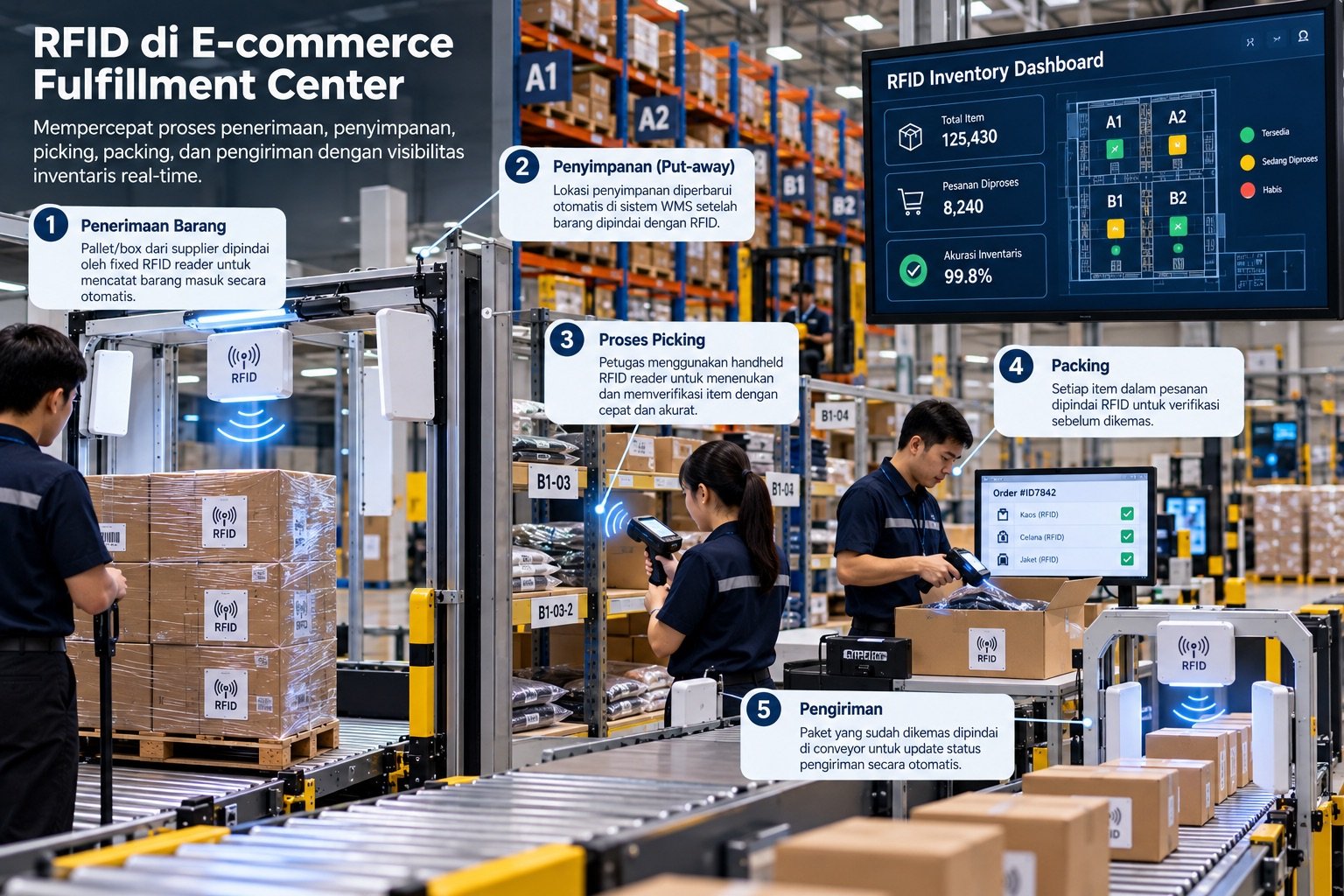
Every item passes through receiving → putaway → picking → packing → outbound. Each point needs verification. With fixed RFID readers at every gate and conveyor, verification happens automatically without adding labor.
Real Time Requirements
Marketplaces need stock updates within minutes. RFID combined with an integrated inventory platform enables automatic stock synchronization across all channels as transactions happen.
5 RFID Use Cases in Ecommerce Fulfillment Centers
1. Automated Receiving: From Supplier to Shelf in 15 Minutes
The old problem: Warehouse staff must unpack every box, scan barcodes one by one, and verify POs manually. Receiving 200 items takes 2 hours.
With RFID:
- The supplier attaches RFID tags during packing at the factory (or you tag on arrival)
- As pallets pass through the fixed reader gate: all items are read at once
- The system automatically compares against the Purchase Order and flags discrepancies immediately
- Putaway instructions are generated automatically based on stock levels and rack locations
Example scenario: RFID may speed up receiving and help verify items. Measure actual processing time and accuracy in an on-site pilot.
2. Highly Accurate Picking: Aiming for Zero Mispicks
Mispicks (picking the wrong item) are one of the largest hidden costs in ecommerce: refunds, returns, bad reviews, and damage to your reputation.
With an RFID handheld scanner:
- The picker scans the rack location → the system confirms which items to take
- When an item is picked, its RFID tag is verified: "Is this actually the ordered item?"
- If the wrong item is picked, an alarm sounds immediately, before it reaches packing
Pick and verify workflow:
- An order arrives → the system generates a pick list with efficient routing by zone
- The picker's handheld shows: "Pick 2x Nike Air Max Size 42, Rack B-12"
- Scan the RFID tag → verify that the EPC matches the order
- Move to the next rack
Result: Picking errors fall from ~2% to < 0.1%, and throughput increases by 60%.
3. Packing Verification: Every Package Checked Before Sealing
Before a package is sealed and the shipping label applied, the RFID system verifies:
- All ordered items are in the box
- There are no extra items (accidental inclusions) and no missing items
- Dimensions and weight match expectations
A fixed RFID reader at the packing conveyor reads all items inside the box automatically. If there's a discrepancy, the conveyor stops and an alert appears on the supervisor's screen.
For fashion, this solves the "extra item" problem, which is common because clothing is stacked and barcode scans miss some pieces.
4. Returns Processing: From "Returns Problem" to "Returns Asset"
Returns are a fact of life in ecommerce, especially in fashion (20 to 30% return rates). The big problem: returned goods often sit in staging for days before being processed back into stock.
With an RFID returns workflow:
- A return parcel arrives → scan the shipping barcode to identify the order
- Open the package → scan all items with RFID to verify their condition and identity
- If sellable: the item goes back into available stock automatically (updating all marketplaces)
- If not sellable: the item moves to a damaged inventory category for separate processing
Result: Return processing time falls from an average of 48 hours to 2 to 4 hours. Available stock increases and overselling decreases.
5. Inventory Visibility Across Warehouses: One Dashboard, All Locations
Growing ecommerce businesses often have:
- A main warehouse in Jakarta
- Regional warehouses in other cities
- 3PL partners for areas outside Java
- Dropshipping suppliers with separate stock
Without RFID: Each location has its own system. Manual stock updates are delayed and inaccurate.
With the Katalyst RFID platform:
- Each warehouse is equipped with fixed readers (entry and exit gates) plus handhelds for operations
- All stock movements are recorded in real time to a central cloud dashboard
- Available stock per SKU per location is visible in one view
- Orders are allocated automatically to the warehouse nearest the buyer (shortening delivery times)
- Automatic alerts fire when stock at a location approaches its minimum level
Integration with Marketplaces & ERP
RFID delivers far more value when it is integrated with your existing technology:
| System | Integration | Benefit |
|---|---|---|
| Odoo ERP | To be assessed | Data sync depends on the agreed integration scope and configuration |
| REST API | ✅ Available | Connection to marketplace APIs (Tokopedia, Shopee, etc.) via middleware |
| Webhook | ✅ Near real time | Stock updates across all channels as movements occur |
| Excel/CSV | ✅ Export/Import | Reports for finance and management teams |
| SAP B1 | Custom integration via REST API | Connects enterprise ERP data |
Marketplace integration scenario:
- An item is picked and moved to outbound staging → a fixed RFID reader reads it
- The Katalyst platform updates stock: -1 unit of SKU X at the Jakarta warehouse
- A webhook triggers the marketplace integration, updating Tokopedia, Shopee, and TikTok Shop at the same time
- Stock updates across channels after the movement is processed; timing depends on network and integration configuration
RFID Implementation in Fulfillment Centers: Phases
Weeks 1 to 2: Assessment & Planning
- Map the process flow: receiving → putaway → picking → packing → outbound → returns
- Identify bottlenecks and touchpoints for reader placement
- Audit SKUs and the tagging strategy (sticker tag vs hang tag vs pallet tag)
Weeks 3 to 4: Hardware Infrastructure
- Install fixed readers at the receiving gate, the outbound gate, and critical conveyors
- Configure handheld scanners for the picking and returns teams
- Set up RFID zones and test antenna placement (critical for minimizing dead spots)
Weeks 5 to 6: Software Integration & Testing
- Connect the Katalyst platform to existing systems (ERP/WMS/marketplace)
- Configure alert rules and workflow automation
- UAT (User Acceptance Testing) with the operations team
Week 7: Go-Live
- Parallel run: RFID and the old system running at the same time
- Validate accuracy and resolve hardware issues
- Train the operations team (picking, packing, supervisor dashboard)
Week 8 Onward: Optimization
- Review KPIs: picking time, mispick rate, receiving speed, shrinkage
- Fine-tune antenna placement and threshold settings
- Expand to advanced features: predictive restocking, routing across warehouses
The example phases above are a planning guide, not a delivery commitment. Set the actual schedule after site assessment and workflow validation.
Lessons from a Timber Processing Scenario
Although this scenario comes from timber processing, its implementation principles also apply to fulfillment centers:
Typical challenges before RFID: Stock audits take 3 days, items are hard to find in staging areas, and movements between production areas are not tracked in real time.
RFID setup: Fixed readers at every area gate for automatic movement tracking, handhelds for spot checks, and a real time dashboard.
Example scenario: Audits may become shorter and stock discrepancies easier to find. Results depend on site conditions and should be measured in a pilot.
For ecommerce fulfillment centers, the same tracking principles can be adapted to their own volume and workflows.
When to Start RFID Implementation
Your fulfillment center is ready for RFID if any of the following apply:
✅ You process hundreds of orders a day and picking errors still occur ✅ You sell on 3+ marketplaces at once and stock frequently falls out of sync ✅ Your return rate is above 10% and processing returns takes too much time ✅ Monthly stock audits take more than a day and the results are inaccurate ✅ High value items (electronics, premium fashion, branded cosmetics) go missing or end up in the wrong locations ✅ You're planning to expand to multiple warehouses or 3PL partnerships
Start before peak season so the system is stable by the time volume spikes (Harbolnas, Indonesia's national online shopping day; Lebaran, the Eid al-Fitr holiday; and Christmas).
Start with a Free Demo
Katalyst Technology provides free consultations and demos specifically for fulfillment centers and ecommerce businesses. We will:
- Review your existing process: Identify the specific bottlenecks in your operation
- Map your workflow: Give you a clear picture of where RFID helps most at your order volume and SKU count
- Propose hardware: Recommend the reader count, tag type, and placement
- Plan the implementation timeline: A realistic schedule that doesn't halt operations
Schedule a Free Demo → | Free consultation → | See the Katalyst Platform →