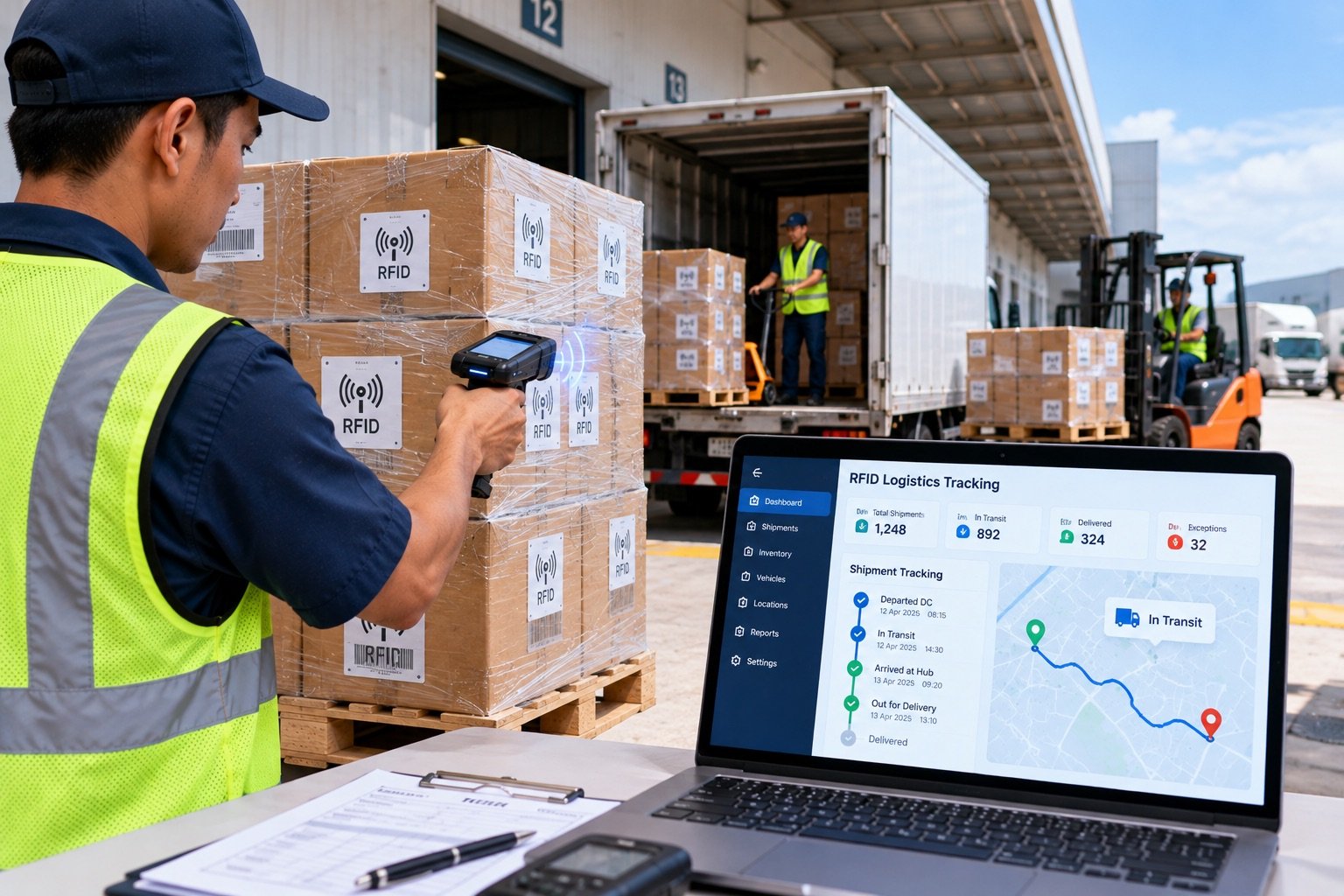
The Core Problem in Distribution Without RFID
In Indonesia's distribution and logistics industry, inventory inaccuracy along the delivery chain is a chronic problem. Industry data shows:
- 2 to 4% of goods lost or misrecorded during distribution
- 40 to 60 minutes per shipment spent on manual pick and pack verification
- Shipping errors (wrong item, wrong quantity) affecting 1 to 3% of all orders
- Daily reconciliation between shipping manifests and physical stock taking hours
For 3PL providers and distributors handling hundreds of SKUs and dozens of shipments a day, these inefficiencies hit both the bottom line and customer satisfaction.
How RFID Transforms Distribution Operations
1. Automated Outbound at the Warehouse Gate
With a fixed reader installed at the loading dock exit, every pallet or carton that passes through is logged in the system automatically, with no manual scanning required.
Before RFID:
- Staff pick items from the shelves ✓
- Each item is verified manually with a barcode scanner ✗ (slow)
- Items are cross-checked against the delivery order ✗ (error prone)
- The system is updated manually ✗ (double entry, delay)
With an RFID fixed reader:
- Staff pick items from the shelves ✓
- The pallet or carton passes through the gate → all tags are read at once ✓
- The system instantly verifies against the delivery order → alerts on any discrepancy ✓
- Outbound is logged in real time → no manual system update needed ✓
Result: Outbound verification drops from 40 minutes to 8 to 10 minutes per shipment.
2. Accurate Inbound Receiving
When goods arrive from suppliers, RFID makes bulk receiving far faster than barcode scanning:
- Scan an entire pallet or carton in a single handheld sweep (3 to 5 seconds for 50+ items)
- The system automatically compares against the Purchase Order and highlights over or short deliveries
- Photo documentation supports insurance claims for damaged goods
- An accurate inbound log prevents disputes with suppliers
3. Real Time Inventory Visibility Across the Network
For distributors with multiple warehouses or transit hubs, RFID provides live stock visibility at every node:
| Node | Data Available |
|---|---|
| Central warehouse | Stock per SKU, per area, per pallet, updated on every scan |
| Transit hub | Item arrival confirmation, transfer status |
| Last-mile delivery | Verification of items loaded onto the driver's vehicle |
| Customer | Delivery confirmation (if required) |
4. Improving Picking Accuracy
Picking errors are the leading cause of customer complaints and returns. With RFID:
- Guided picking: The system directs staff to the item's location using the handheld's proximity signal
- Verification scan: Before packing, a scan confirms the correct item was picked
- Mismatch alert: If an item doesn't match the order, the system triggers an immediate audio and visual warning
In FMCG distribution with many similar SKUs, RFID can help reduce picking errors. Measure the impact based on the verification process and item conditions.
5. Last-Mile Tracking with RFID Tags
For B2B distribution to corporate customers, RFID tags on cartons or pallets enable:
- The driver scans the tags at delivery → the system logs receipt automatically
- Returns are instantly traceable (scanning the tag shows exactly which delivery it came from)
- If the customer also uses RFID, two-way data integration is possible via API
Example Scenario: Fixed Reader Automation at a Timber Processing Plant
Consider a timber processing plant that installs a fixed reader at the entrance to its production area to automate pallet movement logging.
Before RFID:
- Operators have to scan every timber pallet entering the production area by hand
- Scans are often missed → system stock drifts away from physical stock
- Manual reconciliation at the end of each shift takes 1 to 2 hours
After the fixed reader:
- Every pallet passing through the gate → automatically logged as outbound in Katalyst
- No manual scanning for routine outbound
- Stock records stay accurate in real time with no extra effort from operators
- Stock audits that took 3 days can be completed in about 4 hours
The same principle applies directly to distribution: fixed readers at loading dock doors, an RFID gate at the warehouse entrance, or a tunnel reader on a conveyor belt.
Implementation Steps for Distribution
Phase 1: Assessment (Week 1)
- Map the distribution flow: inbound receiving → putaway → picking → packing → outbound
- Identify bottlenecks and the points with the most errors
- Select hardware: handhelds for picking, a fixed reader for the loading dock gate
Phase 2: Tagging & Setup (Week 2)
- Apply RFID sticker tags to every carton or pallet
- Configure the Katalyst Platform: warehouse areas, SKU master data
- Install a fixed reader at the loading dock (if applicable)
- Set up API integration with your existing ERP or WMS (Odoo, SAP, etc.)
Phase 3: Parallel Run (Week 3)
- Run RFID alongside the existing system for one week
- Compare results and verify RFID accuracy against manual counts
- Train the team: picking, packing, inbound receiving, outbound verification
Phase 4: Go-Live (Week 4)
- Retire manual processes for the functions RFID covers
- Monitor closely during the first week
- Fine-tune fixed reader settings (power level, scan zone) for your layout
ERP & WMS Integration
API integration with distribution systems can be assessed based on available APIs and workflow requirements:
| System | Status |
|---|---|
| Odoo ERP | To be assessed based on version and workflow |
| SAP | Custom integration via REST API |
| Accurate Online | Custom integration via REST API |
| Custom WMS | ✅ Via REST API, flexible |
With a compatible bidirectional integration, an outbound event can update ERP stock without duplicate entry. The exact flow depends on the systems and agreed integration scope.
Recommended Hardware for Distribution
UHF RFID Handheld Scanner
- Use for: Picking, receiving, cycle counting
- Read range and speed depend on the reader, tag, item, and site conditions; validate through a site survey
- Best for: Operations of all sizes
Fixed Reader at the Loading Dock
- Use for: Automated outbound and inbound at the gate
- Read range and throughput depend on the reader, tag, item, and site conditions; validate through a site survey
- Key benefit: Eliminates manual scanning at your busiest chokepoint
RFID Pallet Tags
- Durable, suitable for wood, plastic, or metal pallets
- Reusable across many shipment cycles
- Dual identification: RFID, barcode, and QR code on one tag
RFID Sticker Tags for Cartons
- Well suited to high volume operations
- Apply once, read many times
- UV resistant options available for outdoor storage
Conclusion: RFID Is Modern Distribution Infrastructure
RFID can help speed up outbound processing and improve item visibility. Its impact on speed and accuracy depends on the workflow, reader placement, and item conditions, so measure it in a pilot.
Ready to modernize your distribution operations? Book a free consultation or schedule a free demo with the Katalyst team.