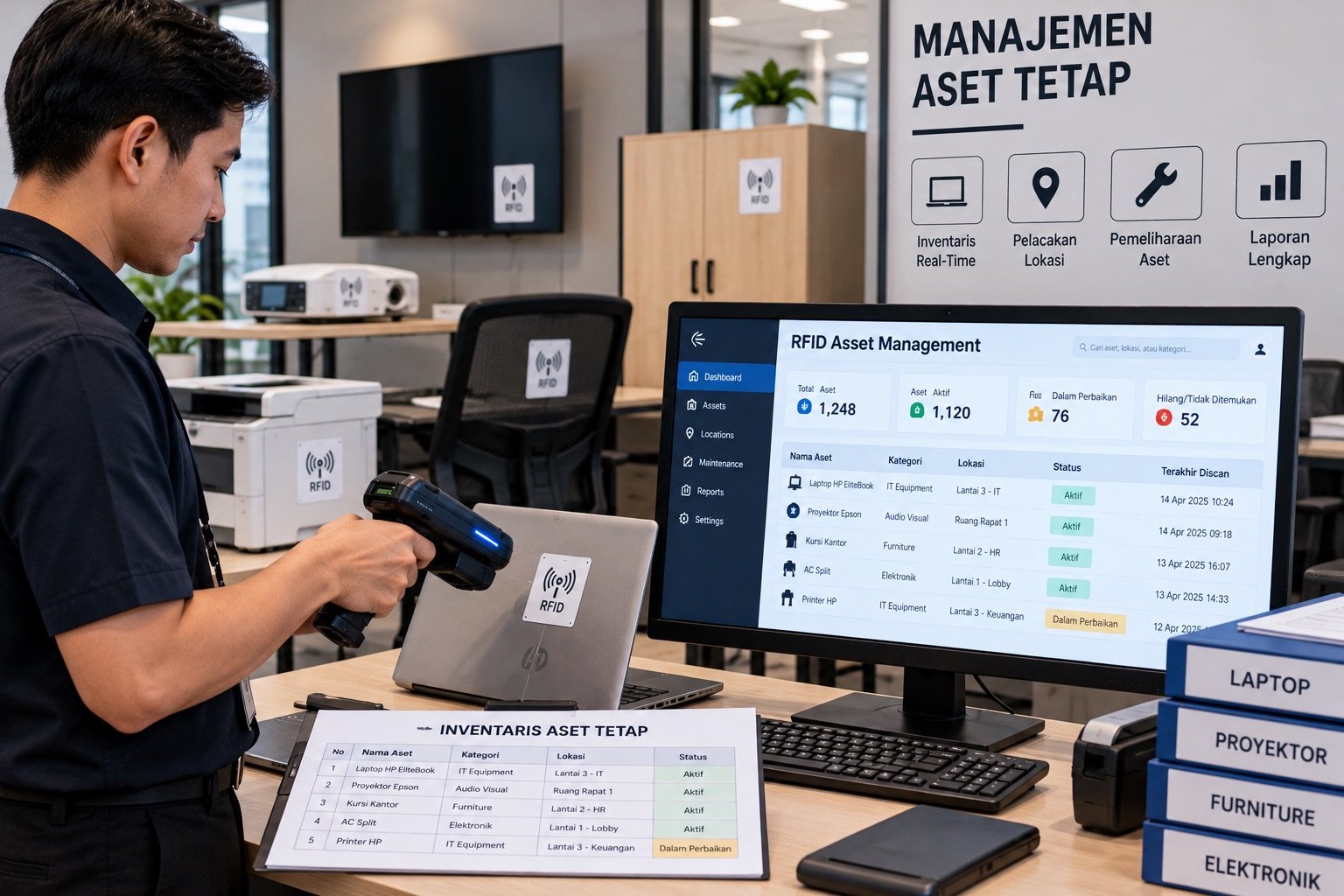
The Classic Fixed Asset Management Problem
Every Indonesian organization, from manufacturers and retailers to hospitals and government agencies, has fixed assets to track: laptops, servers, printers, chairs, desks, production machinery, and medical devices. And nearly all of them face the same problems:
- Ghost assets: Items recorded in the books but physically missing (lost, broken, or moved without authorization)
- Painful annual audits: Teams spend 2 to 3 days walking through buildings, scanning barcodes one by one
- Inaccurate locations: "That laptop is on floor 3", when it actually moved to floor 1 six months ago
- Missed maintenance: No automatic reminder when service or calibration is due
- Undetected losses: Assets change hands or leave the building without being recorded
There is no single ghost asset rate that applies to every company. Compare the asset register with a physical inspection to measure discrepancies in your organization.
Why Barcodes Aren't Enough for Fixed Assets
Many companies still use barcodes for asset management, but the technology has fundamental limitations:
| Aspect | Barcode | RFID |
|---|---|---|
| Scanning method | One by one, manual | Bulk scan of hundreds at once |
| Line of sight | Must be visible | Not required, works inside drawers and bags |
| Audit speed | Depends on asset count and location | Can be tested in a pilot with suitable readers and workflows |
| Label durability | Easily damaged, dirty, or obstructed | RFID tags last much longer |
| Exit detection | None | A fixed reader at the door detects unauthorized removal |
| Automatic location updates | Not possible | Possible with fixed readers on each floor or room |
How RFID Works for Fixed Asset Management
1. Asset Tagging
Each asset receives the appropriate RFID tag:
- RFID sticker: For laptops, monitors, and printers (flat, non-metal surfaces)
- On-metal RFID tag: For metal assets (machinery, server racks, filing cabinets)
- Hard hang tag: For furniture and assets that can't take a sticker
- Embedded tag: For high value assets that need a concealed tag
Each tag contains a unique EPC code linked to the database record: asset name, serial number, department, location, purchase date, and book value.
2. Scanning & Audit
With a handheld RFID scanner, IT or admin staff can:
- Walk down a floor corridor → the scanner automatically reads all tags within a 5 to 8 meter radius
- Audit a room → measure audit time using the site’s assets and workflow
- Get real time confirmation → the app immediately shows what was found and what's missing
RFID may help speed up asset audits; compare actual timings with the previous process in a pilot.
3. Fixed Readers for Movement Detection
Fixed RFID readers are installed at:
- Building entrances and exits → automatic alert if an asset leaves without authorization
- Floor and division doorways → track asset movement between departments
- Server rooms and equipment rooms → notification if critical equipment is moved
4. Dashboard & Reporting
The Katalyst platform shows:
- The last known location of every asset (based on the last fixed reader to detect it)
- Complete movement history (audit trail)
- A list of assets not found during an audit
- Maintenance schedules and automatic reminders
- Depreciation and book value tracking
- Export to Excel or PDF for external audit requirements
Use Cases: Who Benefits Most
Companies with 200+ IT Assets
Laptops, desktops, monitors, and servers all need tracking. With RFID, IT teams can run weekly inventories in an hour, catch laptops that departing employees haven't returned, and keep track of equipment taken home for remote work.
Hospitals & Clinics
Medical equipment such as infusion pumps, wheelchairs, and vital signs monitors moves between wards constantly. RFID lets staff locate specific equipment in minutes, not hours.
Hotels & Hospitality
Linens, TVs, in-room safes, and furniture are all trackable. Items removed by guests can be detected before checkout.
Government Agencies & State-Owned Enterprises
Fixed assets must be reported every year to the Audit Board of Indonesia (BPK) or to internal audit. RFID shortens the audit process from weeks to days and produces accurate, verifiable reports.
Manufacturing & Factories
Track production tools and jigs, QC equipment, and floor machinery. Prevent the loss of expensive tools and make sure every shift has the equipment it needs.
Implementation: Step by Step
Phase 1: Inventory & Tagging (Weeks 1 to 2)
- Export the asset list from your existing system (Odoo, Excel, SAP)
- Physically check each asset and verify its condition
- Attach an RFID tag to each asset
- Import the data into the Katalyst platform, mapping each EPC to its asset details
Phase 2: Reader Setup & Software (Weeks 2 to 3)
- Install fixed readers at strategic points (main doors, server room, etc.)
- Configure zones and rules in the platform
- Train the IT/admin team on the handheld scanner
- Run a first test audit and reconcile the data
Phase 3: Go-Live & Audit Cycle (Weeks 3 to 4)
- Run the first full RFID audit and compare it against the old data
- Flag ghost assets for physical investigation
- Schedule regular audit cycles (monthly or quarterly) in the system
- Activate exit alerts and maintenance reminders
Benefits You Can Expect
Audit Time Savings
- Before RFID: 2 staff × 3 days = 48 work hours per audit cycle
- After RFID: 2 staff × 4 hours = 8 work hours per audit cycle
- Savings: 40 work hours per audit cycle
- Annual savings (4 audits a year): 160 work hours
Ghost Asset Recovery
A physical audit can find assets missing from their recorded locations, as well as records that do not match the actual assets. Findings vary by organization and should be verified before replacing or writing off assets.
Asset Loss Prevention
Fixed readers at doors detect unauthorized asset removal as it happens, so missing equipment is flagged the same day instead of at the next annual audit.
Integration with Existing Systems
The Katalyst platform integrates with:
- Odoo Fixed Assets: Bidirectional sync of asset data, location, and status
- SAP Asset Accounting: Via REST API for book value and location sync
- Microsoft Excel/CSV: Import and export for audit reporting
- Email: Automatic notifications for exit alerts and maintenance schedules
Conclusion
Fixed asset management with RFID can reduce manual recording and help teams review asset movements. The impact on audit time and asset findings depends on coverage, data quality, and implementation configuration.
For companies with many fixed assets, a pilot can help measure RFID's value and identify asset data that needs attention.
Request a scope for your company's assets → | Free consultation with Katalyst →