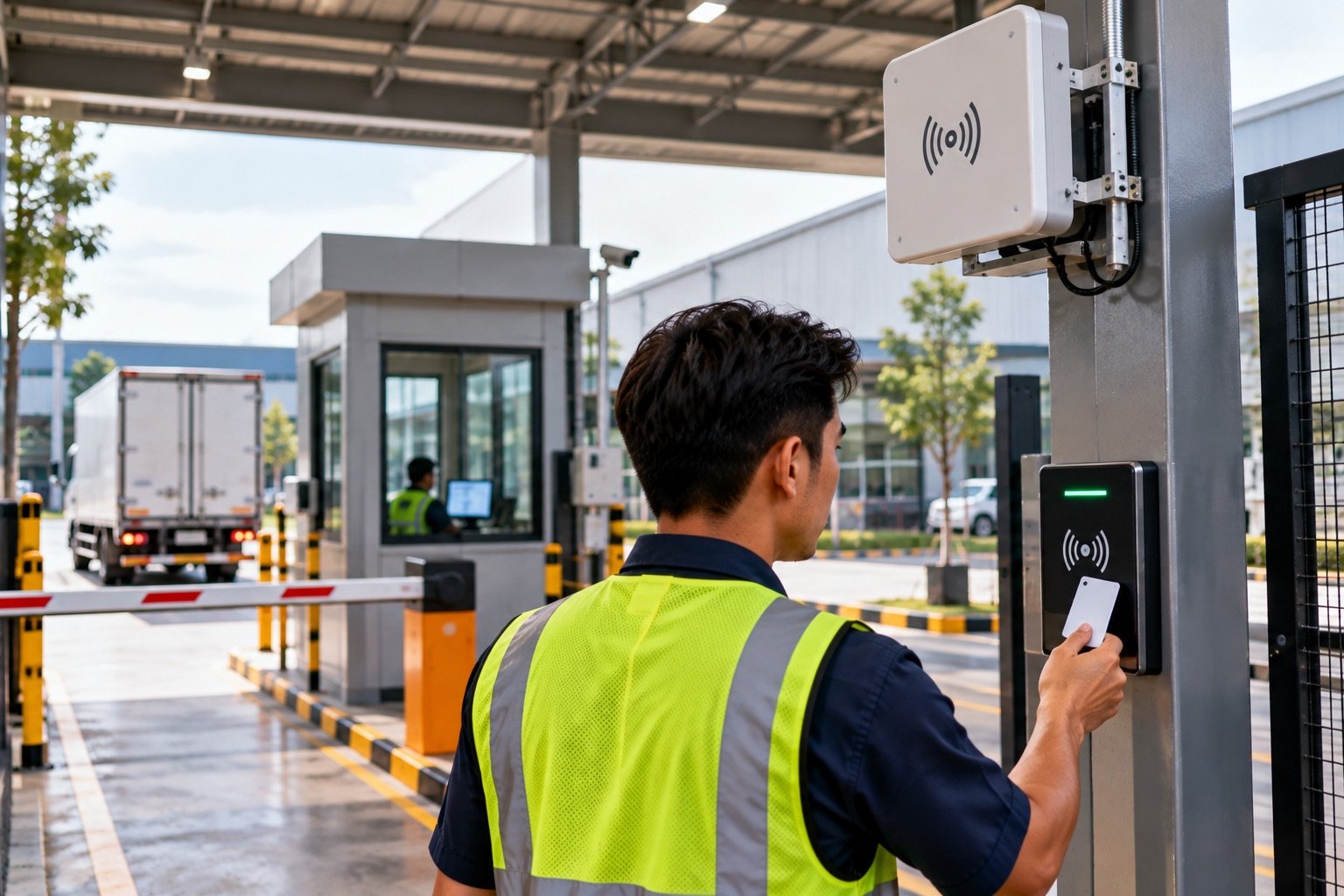
What Is a Fixed RFID Reader?
A fixed RFID reader is a reading device mounted permanently at a strategic location, such as a warehouse door, conveyor belt, loading dock, or outbound portal, to read RFID tags automatically, without human intervention.
Unlike handheld scanners carried by staff, a fixed reader works 24/7 at its location. Every tagged item that passes within its range is instantly identified, logged, and synchronized to the inventory system in real time.
This is the foundation of a truly automated warehouse.
How Does a Fixed RFID Reader Work?
System Components
A fixed reader system consists of:
- Controller/reader unit: The brain of the system, typically a UHF RFID reader with 4 to 8 antenna ports (e.g., Impinj Speedway R420, ThingMagic M6)
- RFID antennas: Mounted on the left and right of a doorframe or conveyor frame, with a range of 1 to 8 meters per antenna
- RFID tags on each item, pallet, or bin
- Network connection: The reader connects to a server via Ethernet or Wi-Fi and transmits data in real time
- Software platform: Receives events from the reader, logs item movements, and updates stock
The Workflow When an Item Passes Through
Tagged item enters antenna range
         ↓
Antenna emits RF signal at 860 to 960 MHz
         ↓
Tag backscatters → sends its EPC (unique 96-bit code)
         ↓
Reader decodes EPC → sends event to server
         ↓
Platform update: item X leaves Location A, enters Location B
         ↓
Real time stock updated automatically
Read and data update times depend on the reader, network, and system configuration.
Reading Many Tags at Once
The key advantage of a fixed reader: it reads hundreds of tags at once using the EPCglobal Gen2 anti-collision protocol. A single pallet carrying 50 different items can pass through a doorway in one second with every item identified.
Read rates depend on the tags, item materials, interference, and configuration. Test with sample items on site before setting a target.
Types of Fixed RFID Reader Installations in Warehouses
1. Gate Readers (Doorway Portals)
The most common setup. Two antennas mounted on either side of a warehouse doorframe form an "RFID portal." Every item entering or leaving is read automatically.
Use cases:
- Outbound verification: confirm that every item in the order has been loaded onto the truck
- Inbound receiving: automatically log all new goods arrivals
- Transfers between warehouses: track movements between locations
Example scenario at a timber operation: Fixed readers at an outbound gate can help verify items passing through. Read rate and verification time depend on tags, items, movement speed, and configuration; measure them in an on-site pilot.
2. Conveyor Readers
Antennas are mounted above or beside a conveyor belt. Ideal for:
- Manufacturing plants: Tracking products as they move between production stages
- Sortation warehouses: Identifying packages before routing them to the correct lane
- Ecommerce fulfillment: Scanning items automatically as they move to packing stations
The challenge with conveyors: belt speeds can reach 0.5 to 3 m/s, so readers must be configured in a high speed scan mode to avoid missing tags.
3. Dock Door Readers
Mounted at loading docks, at the opening of each truck bay. The entire load of every truck entering or leaving is read automatically.
Benefits:
- No manual outbound verification
- Real time shipment tracking from warehouse to truck
- Automatic discrepancy alerts if items don't match the PO/DO
4. Fixed Readers for Work in Progress (WIP) Tracking
In manufacturing environments, fixed readers are installed at each work station or transition area to track semi-finished goods (WIP).
Example flow in a timber operation:
[Raw Material In] → Gate Reader #1 logs receipt of raw logs
[Sawing Area] → Fixed reader logs wood entering the saw
[Drying Area] → Reader logs transfer to the kiln
[QC Station] → Reader logs QC completion
[Packing Area] → Reader logs finished product ready for shipping
[Outbound Gate] → Gate Reader #2 verifies the shipment
Result: complete real time tracking from raw material to outbound shipment.
5. Fixed Readers for Zone Tracking
Multiple fixed readers are mounted across warehouse zones to track item locations in real time (without a dedicated RTLS/UWB system). An item's location is known from whichever reader last detected it.
Fixed RFID Reader vs Handheld RFID Scanner
| Feature | Fixed RFID Reader | Handheld Scanner |
|---|---|---|
| Operation | Automatic 24/7 | Requires staff |
| Speed | Instant as items pass | 200 to 400 tags/min (while scanning) |
| Range per unit | Depends on the reader, antenna, tag, item, and site | Validate through a site survey |
| Ideal use case | Doors, conveyors, dock doors | Cycle counts, picking, floor audits |
| Human intervention | None | Required |
Bottom line: Fixed readers and handhelds complement each other rather than compete. The best setup combines fixed readers at all critical checkpoints with handhelds for daily floor operations.
Example Scenario: Fixed Reader Outbound Automation at a Timber Processing Plant
Background: Consider a wood processing plant shipping finished goods through an outbound gate. This illustrates a workflow, not client operating data.
Problems Before the Fixed Reader:
- Outbound verification is done manually: staff scan barcodes one by one
- Measure verification time and error rates in the current process
- Use order reconciliation to identify mixed-up or missing items
Solution: 2 Fixed Reader Units at the Outbound Gate
Setup:
- 2× Impinj R420 readers (4 antennas each)
- 8 antennas in total, forming a portal 3.5 meters wide
- Pallets and cartons tagged when production is completed
- Katalyst Platform automatically matches detected items against the DO (Delivery Order)
Pilot Measures:
| Metric | Before | After |
|---|---|---|
| Verification time per truck | Current process baseline | Pilot result |
| Order discrepancies | Current process baseline | Pilot result |
| Wrong shipment claims | Existing recorded baseline | Track after implementation |
| Verification staffing | Current process baseline | Pilot result |
| Trucks handled per day | Current capacity | Validate actual capacity |
| Outbound human error rate | Measure current baseline | Measure in pilot |
| Wrong shipment claims/month | Existing recorded baseline | Track after implementation |
| Outbound verification staff | Current process baseline | Pilot result |
| Trucks shipped per day | Current capacity | Validate actual capacity |
Use the pilot results to assess effects on verification time, order discrepancies, staffing, and throughput.
Katalyst Fixed RFID Reader Specifications
Fixed readers used in the Katalyst ecosystem:
Hardware:
- Standard: 4-port UHF reader (860 to 960 MHz, EPC Gen2 / ISO 18000-6C)
- Antennas: Circularly polarized, 6 to 9 dBi gain, 1 to 8 meter range (adjustable output power)
- Connectivity: Ethernet, Wi-Fi, USB; LLRP (Low Level Reader Protocol)
- Environment: IP54 rated, operating temperature -20°C to +55°C
Software Platform:
- Real time event streaming to the Katalyst Platform
- Rule engine: trigger alerts if unexpected items are detected
- Automatic reconciliation with SO/DO/PO
- Direction sensing: distinguishes items entering from items leaving through a single portal
Integration:
- Odoo ERP: automatic sync to stock.move whenever a tag is read
- Webhook API: sends events to external systems; delivery time depends on network and integration configuration
- Mobile app: real time push notifications to supervisors when a discrepancy occurs
When Do You Need a Fixed RFID Reader?
Fixed readers are most useful when you have:
- ✅ High checkpoint volume: 50+ pallets or items passing through one point per hour
- ✅ Critical checkpoints: Points where a mistake has serious consequences (a wrong shipment means a customer claim)
- ✅ 24/7 or multi-shift operations: Handhelds need staff; fixed readers don't
- ✅ Manufacturing with WIP tracking: Semi-finished goods tracked at multiple workstations
- ✅ High volume distribution: 10+ outbound trucks per day
Fixed readers may be overkill if:
- Volume is very low (fewer than 20 items a day at the checkpoint)
- There is no doorway or portal to mount antennas on
Fixed Reader Integration with the Katalyst Platform
The Katalyst Platform is designed from the ground up to support fixed readers:
- Zone configuration: Define each reader as "Receiving Door", "Outbound Gate", "Line A", etc.
- Smart rules: "If item X is detected at Gate OUT but its status is still IN, send an alert to the supervisor"
- Automatic DO matching: Items detected at outbound are automatically matched against pending Delivery Orders
- Dashboard: Review gate activity based on received reader events
- History & audit trail: Every fixed reader event is stored with a timestamp for compliance
Odoo integration: Every fixed reader event can automatically validate stock transfers in Odoo, with no need for manual confirmation by a user.
Conclusion: Fixed RFID Readers Are Checkpoints That Never Sleep
Fixed RFID readers turn critical warehouse checkpoints into automated verification systems that run 24/7 without relying on manual checks.
They save staff time, reduce verification errors, and raise throughput at your busiest checkpoints.
The timber processing scenario above is illustrative. Measure the effect of fixed readers on outbound time and shipping capacity in the actual operating environment.
Ready to eliminate your warehouse checkpoint bottleneck?
Free consultation with the Katalyst team → | See all RFID hardware →