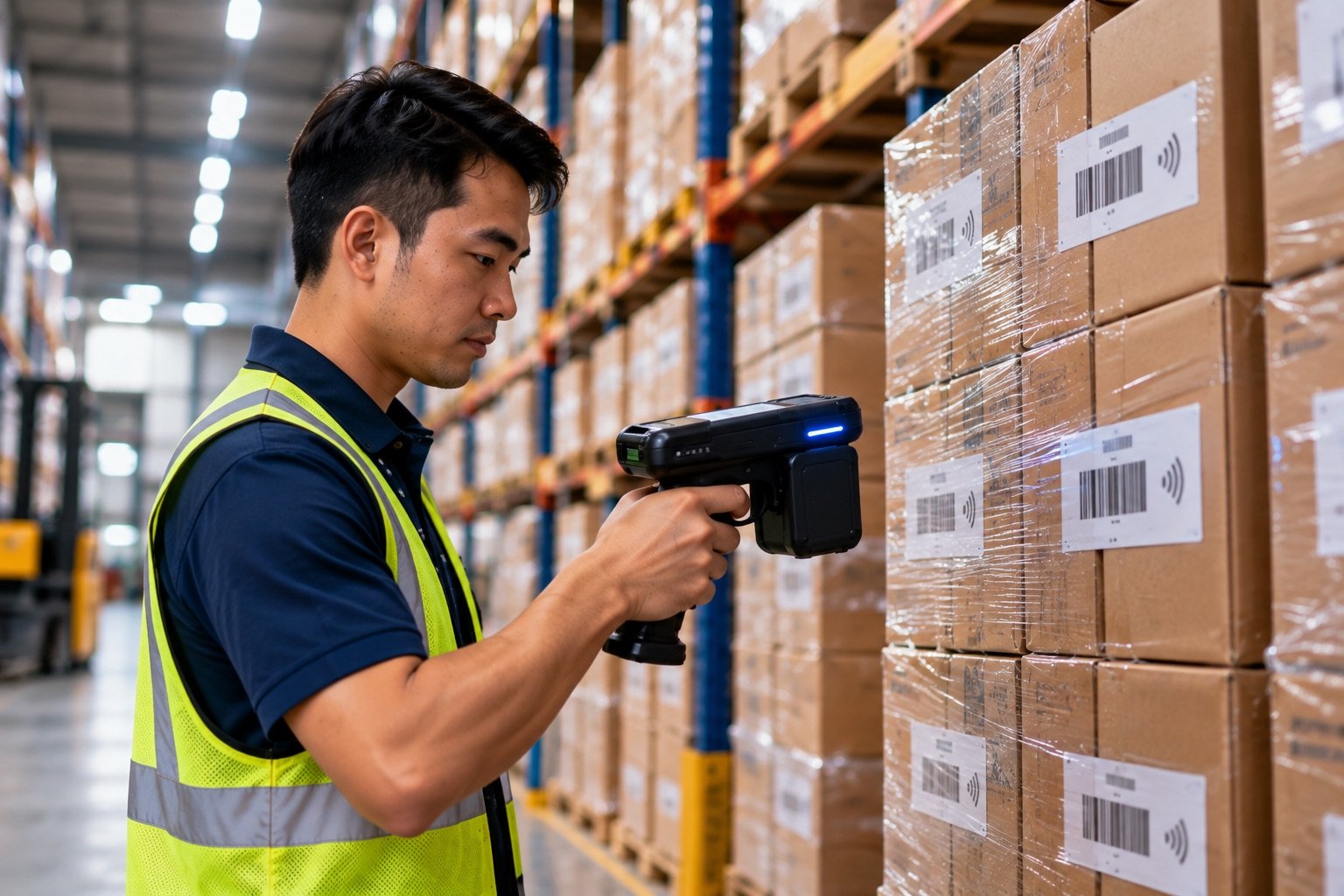
What Is RFID?
RFID (Radio-Frequency Identification) is a technology that uses radio waves to identify and track objects automatically. Each item carries an RFID "tag" containing a tiny chip and antenna. When the tag is within range of a reader, its identification data is transmitted wirelessly, with no line of sight or manual scanning required.
LF, HF, and UHF RFID: What's the Difference?
There are three common RFID frequency bands:
- LF (Low Frequency, 125 to 134 kHz): Short range (< 10 cm), used for access cards and animal tracking
- HF (High Frequency, 13.56 MHz): Medium range (< 1 m), used for NFC payments and library systems
- UHF (Ultra High Frequency, 860 to 960 MHz): Commonly used for warehouse and inventory management; range depends on the reader, tag, item, and site conditions
Why UHF RFID for Business?
UHF RFID is the natural choice for inventory management because it offers:
- Long read range: UHF readers can read tags at varying distances depending on the reader, tag, item, and site conditions
- High speed: Read multiple tags in one process, while barcodes must be scanned one at a time
- No line of sight needed: The reader doesn't need to face the tag; it only needs to be within range
- Bulk scanning: One scan can capture multiple tags; validate capacity on site
- Individual item tracking: Each tag carries a unique ID (EPC), giving you visibility down to each unit
Components of a UHF RFID System
To deploy UHF RFID in a warehouse or factory, you need:
1. RFID Tags
Attached to every item. Tags come in many form factors, including stickers, hang tags, and pallet labels, and can be reusable or disposable.
2. RFID Readers
Devices that read the tags. There are three main types:
- Handheld scanner: For mobile operations on the warehouse floor
- Desktop USB reader: For office tasks such as receiving and verification
- Fixed reader: Mounted permanently at gates for fully automatic scanning
3. Software Platform
The system that processes data from the readers: real time dashboards, inventory tracking, audit workflows, reporting, and ERP integration.
Conclusion
UHF RFID can help speed up inventory work, but results depend on the items, environment, and workflow. A stock count that takes several days may become shorter after the process is tested and adjusted. For businesses modernizing inventory operations, RFID may be a useful next step beyond barcodes. Schedule a free consultation.